

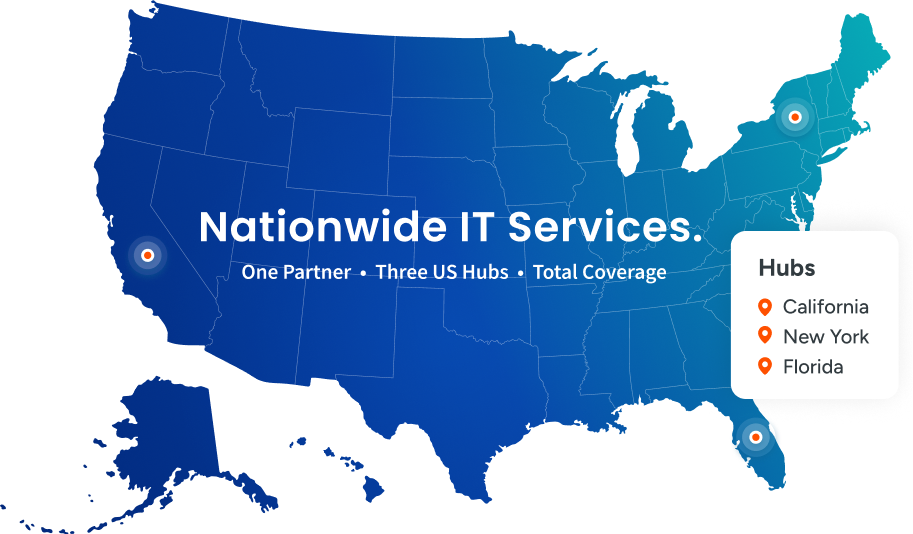
“Do you cover my city?”
Yes. That’s the short answer, and it’s the question every multi-site buyer asks first. The longer answer is the model below — because “coverage” from most MSPs means a subcontractor directory and a prayer. Turner’s coverage is a delivery system: centralized operations that never sleep, field and embedded staff who go where your people are, and a logistics layer that moves hardware to all of it. Headquartered in Burbank since 1987. Delivering wherever you operate — including international offices, through a vetted local partner network.
The three-layer delivery model
Layer 1: Centralized Operations
The always-on core. A 24/7 Service Desk and a NOC monitoring client infrastructure in real time, operated from headquarters and extended to true around-the-clock coverage by our Manila support center. ServiceNow-powered ITSM with intelligent automation — including TechTron, our Level 0 AI agent — handles the routine so engineers handle the real work. 24/7 managed SOC and MDR coverage is delivered through our managed-SOC partner, monitoring across your endpoint, identity, and network stack — built on the platforms you already run. 90% first-call resolution. Under 30 seconds average wait.
Layer 2: Field Services & Staff Augmentation (anywhere in the U.S. and beyond)
Hands on hardware and people on teams — wherever the work is. Certified field technicians dispatched to all 50 states for installations, repairs, IMAC work, and rollouts, coordinated from the nearest hub and tracked in the same ticket system as everything else. Vetted W-2 staff augmentation places engineers, analysts, and project managers directly onto client teams — a manufacturing floor in Kentucky, a corporate campus in Raleigh, a studio lot in Los Angeles. For U.S.-headquartered clients with offices abroad, we coordinate onsite support through a vetted local partner — one Turner account team, one ticket trail, details scoped at engagement setup.
Layer 3 Depot & Logistics (Burbank · New York · Orlando)
The physical-world layer most MSPs don’t have. Hardware staging, imaging, asset tagging, warehousing, direct-to-user shipping, return logistics, and depot repair — run from facilities on both coasts so a Northeast rollout ships from New York and a Southeast plant refresh stages out of Orlando. Devices arrive ready to work, not ready to configure.
Two decisions, both yours
A Turner managed engagement is scoped on two independent axes: the tier — how much of the stack we manage — and the sourcing model — where your support is staffed from. They're separate choices. Any tier can run hybrid or fully onshore. You decide both up front, and both go in the SLA.
Essential
- 24/7 service desk
- NOC monitoring and alerting
- ITSM in ServiceNow or ConnectWise
- TechTron Level 0 automation
- Endpoint protection
- Identity hardening (managed EDR plus MFA and conditional access)
Recommended for teams that need reliable coverage and a clean ticket trail without handing over the whole stack.
professional
- Everything in Essential
- Intelligent automation
- Patch and endpoint lifecycle management
- Network and firewall management
- Expanded reporting
- Monthly operational reviews
The most common engagement: for organizations that want their environment actively managed, not just monitored.
enterprise
- Everything in Professional
- 24/7 managed SOC and MDR
- Security awareness training
- vCISO advisory
- Compliance support
- Advanced analytics
- Dedicated resources
Built for regulated and security-focused organizations requiring enterprise-grade protection and governance.
Choose your sourcing — where the desk is staffed

Hybrid (Default)
U.S.-led core hour, with our Manila support center covering after-hours and overflow. How every tier ships by default — what keeps coverage 24/7 and cost-effective.

100% Onshore (on request)
Every shift, every call, staffed from the U.S. Available on any tier and written into the SLA. The default request for regulated industries and explicit onshore-only requirements.
What a multi-site engagement looks like

Setup:
Corporate HQ in Los Angeles. Studio and Creative Offices in New York and Washington DC.
Turner runs:
- The 24/7 Service Desk and NOC from Burbank
- Field technicians dispatched from NY-metro and DC-metro coverage zones;
- Hardware staged from the NY depot for the Northeast sites;
- Microsoft 365 + Intune support in all areas.
One Partner
HQ + Metro Offices + Service Desk +NOC + Depot + Technicians — one SLA, one team, one accountable partner.
How an engagement starts

Map the footprint
A discovery sprint focused on geography (where your people and sites are), density (how many users per site), and operating rhythm (when they need help). Output: a coverage map of your organization against our delivery network.


Pick the tier and the sourcing
Your tier (Essential, Professional, or Enterprise) and your sourcing model (hybrid or 100% onshore) — priced and put in writing. Field-dispatch zones, depot routing, and escalation paths documented per site.


Onboard and pilot
Service desk onboarded and fully integrated to your environment, runbooks documented, pilot site validated before the broader rollout. Typical onboarding runs 30–60 days depending on site count.


Operate and review
Monthly operational reports, quarterly business reviews, SLA monitoring, and right-sizing recommendations as your footprint changes.

Frequently Asked Questions
Yes — onsite field service in all 50 states, coordinated from the hub nearest the work and tracked end to end in one ticket system. We have direct technician coverage in major metros and SLA-backed partner coverage in secondary markets, with the same chain-of-custody and quality standards regardless of who is physically dispatched. . For international offices, we coordinate onsite support through a vetted local partner — same single point of accountability, scoped when we define the engagement.
Yes — for clients with a U.S. headquarters and an office abroad, we source and manage a vetted local partner for onsite work at that location, coordinated by your Turner account team under the same ticketing system and single point of accountability. Because every footprint is different, the specifics — which partner, what scope, what SLA — are defined when we scope the engagement.
One. That’s the point of the model — centralized operations, a national field network, and coast-to-coast depots under a single contract, single SLA, and single account team. No franchise of subcontractors, no per-region finger-pointing.
Yes. For sites with sufficient density (typically 200+ users), we embed a dedicated onsite technician — a Turner employee who knows your environment and reports through our management with your team’s priorities.
It ships from the nearest depot — imaged, configured, asset-tagged, and either staged at the site or shipped direct to users. Old equipment flows back through return logistics with certified data destruction where required.
Discovery to operating typically runs 30–60 days depending on site count and complexity. Single-site engagements onboard faster; multi-state engagements get a phased rollout with a pilot site first.
Tell us where your people are. We'll show you the coverage plan.
30-minute scoping call. We’ll map your sites against our delivery network and follow up with a written coverage plan — hubs, dispatch zones, depot routing, and the tier recommendation that fits.